Why Detecting a Fall Is Harder Than It Sounds
Many automatic fall-detection systems use accelerometers, gyroscopes or other sensors to measure changes in movement, speed, direction, position or height. An algorithm then evaluates those measurements and decides whether the movement appears consistent with a fall.
The difficulty is that real falls do not all follow the same pattern.
A person may fall suddenly, slide gradually from a chair, lower themselves while holding onto furniture, fall against a wall or land on a bed or another soft surface. Some people remain still afterward. Others continue moving while trying to get up.
At the same time, ordinary activities can resemble parts of a fall. Sitting down quickly, bending, removing a pendant or dropping the device can sometimes create movements that an automatic system may interpret incorrectly.
Fall-detection developers therefore face a basic tradeoff. Increasing sensitivity may help a system recognize more possible falls, but it can also increase false alarms. Reducing false alarms may increase the chance that a lower-impact or less typical fall will not be recognized. Research continues to improve that balance, but no current setting can eliminate both problems completely.
Laboratory Falls Are Not the Same as Real Falls
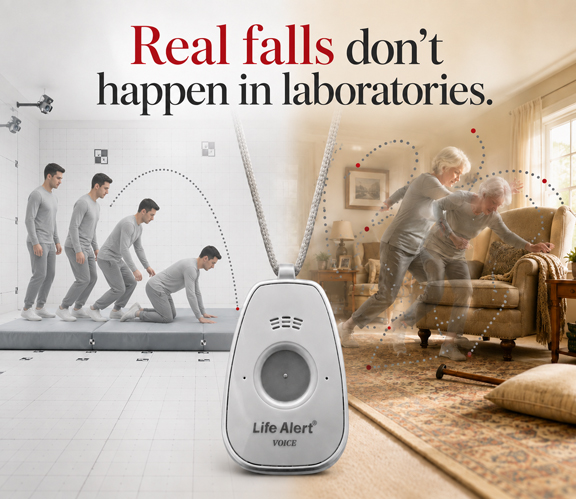
Many fall-detection systems have been developed and evaluated using simulated falls performed by healthy volunteers in controlled environments. Participants may know that they are about to fall, know how they are expected to land and know that a padded mat is beneath them.
An unexpected fall involving an older adult can look very different.
A 2026 scoping review published in Frontiers in Public Health examined 243 studies involving wearable and sensor-based fall detection and pre-impact prediction. More than half relied primarily on simulated laboratory falls, while fewer than one-third reported real-world validation in older adult settings. The review identified substantial remaining gaps between technical development and long-term real-world use. In the smaller number of studies that have directly tested algorithms against real-world falls rather than simulated ones, detection rates have generally come in lower than the lab results suggested.
What Real-World Research Has Found
A widely cited 2012 study evaluated 13 published accelerometer-based fall-detection algorithms against a database of 29 actual, unplanned falls involving older adults at high risk of falling.
What real-world research has found
57%
Average sensitivity across 13 algorithms tested against real falls in a 2012 study
29
Actual, unplanned falls in the evaluation database
3–85
False alarms in 24-hour recordings of three participants, depending on the algorithm and the individual.
These were research algorithms published before 2012 — not direct tests of every fall-detection product currently on the market. However, the results demonstrated that algorithms reporting strong performance with simulated falls could perform substantially differently when evaluated against real-world falls.
A later study published in 2020 analyzed sensor data associated with 143 real-world falls and applied machine-learning methods intended to improve detection. Its best-performing method achieved sensitivity above 80%, an improvement over many earlier approaches, but it still did not recognize every fall and continued to produce false alarms.
These studies do not establish a single failure rate for every commercial fall-detection device. Products use different sensors, algorithms and operating requirements. They do show why real-world validation matters and why laboratory accuracy alone does not guarantee dependable performance in an actual emergency.
What Companies Selling Fall Detection Tell Their Customers
The limitations in this section come from companies that sell automatic fall detection. They are not Life Alert product disclosures. Life Alert does not offer automatic fall detection.
Official manuals and support materials published by several major fall-detection providers state that:
- Automatic fall detection does not detect 100% of falls.
- Users should press the emergency button whenever they are able.
- False alerts may occur.
- Detection may work best when the device is worn around the neck and outside clothing.
- Certain gradual, cushioned or lower-impact falls may not generate the movement pattern required to activate an alert.
For example, one provider states that fall detection does not detect every fall and may sometimes send a false alert. Another warns that its detector may interpret the movement of putting on or removing the pendant as a fall. One provider’s own documentation states its algorithm requires roughly 20 to 30 seconds after a possible fall to confirm the event before sending an alert. Another describes a similar built-in delay: its system looks for a sudden downward motion followed by about 30 seconds without further movement—meaning a person who falls but gets back up quickly may not trigger an automatic alert at all. Several providers instruct customers to press the help button whenever possible, even though those customers are paying for automatic detection.
That instruction is worth noting. Automatic fall detection is intended to provide an additional alert when someone cannot press a button, but the companies offering the feature do not present it as a guarantee — and their own documentation continues to treat manual button activation as the preferred action whenever the user is able to press.
How Life Alert Works Instead
Life Alert uses a direct and clearly defined emergency process:
1
Press
The member presses a wearable or wall-mounted Life Alert button.
2
Connect
The signal reaches a Life Alert Emergency Dispatch Center.
3
Respond
A trained dispatcher answers — never a recording or automated menu. They assess the emergency and send appropriate help.
4
Stay
The dispatcher notifies designated family and stays on the line until help physically arrives.
Life Alert owns and operates its U.S.-based Emergency Dispatch Centers rather than outsourcing this essential part of the service. Dispatchers are trained specifically for Life Alert emergencies and remain with the member throughout the emergency response.
When a member is conscious and able to press the button, direct activation eliminates the need for an algorithm to first interpret whether the person’s movement meets a technical definition of a fall. The person experiencing the emergency makes the decision that help is needed.
Protection for More Than Falls
A fall is only one reason a senior living alone may need help.
A Life Alert member can press the button because of chest pain, breathing difficulty, dizziness, sudden weakness, a possible stroke symptom, a medication reaction, a bathroom emergency, a fire, a home intrusion or simply because the person feels unsafe.
Automatic fall detection looks for a particular physical movement. A Life Alert button allows the member to request help for the emergency that is actually occurring.
Life Alert dispatchers respond to medical events, falls, fires, home intrusions and other situations in which the member needs assistance.
To discuss protection options with a Life Alert representative, call .
The Technology Life Alert Uses
Life Alert's decision not to offer automatic fall detection should not be mistaken for a lack of advanced technology. Life Alert uses technology where it can provide practical, continuous protection and a direct connection to trained human help.
Life Alert medical alert devices never need charging. There is no charging schedule to remember and no period when the member must remove the device and leave it on a charger.
For members and families, that means one less daily responsibility and greater confidence that the button is ready, day or night. Life Alert batteries can last for years, depending on the device, allowing protection to remain with the member continuously.
The HELP On-the-Go + GPS unit connects the member directly to a Life Alert dispatcher at the press of a button and uses GPS technology to help locate the member away from home, where cellular service is available.
The Life Alert Micro Voice Pendant provides two-way communication through the wearable itself, allowing the member to speak directly with a trained dispatcher.
Technology sends the signal, but a trained person manages the emergency.
Life Alert dispatchers assess what is happening, contact the appropriate responders, notify family members and stay on the line until help physically arrives. The member is not left alone after the signal has been received.
Life Alert's wearable devices are waterproof, allowing members to keep their protection with them in the shower and bathroom—places where a telephone may be out of reach and removing a medical alert button could leave the person unprotected.
The Life Alert Help Button provides another option for areas such as the shower or bathroom. It is waterproof, never needs charging and provides two-way voice communication with Life Alert's emergency response team. One press gives the member a direct way to call for help without having to reach a telephone.
A Deliberate Technology Decision
Life Alert does not use a feature simply because it appears on a product comparison chart.
Automatic fall detection may continue to improve. Today, however, independent research shows continuing differences between simulated and real-world performance. Companies selling the feature continue to warn that it may miss falls, may generate false alerts and should not replace pressing the emergency button whenever that is possible.
Life Alert has therefore chosen a different form of modern protection: waterproof medical alert devices that never need charging, two-way voice and GPS technology, company-owned U.S. Emergency Dispatch Centers, and trained human dispatchers who stay on the line until help physically arrives.
Since 1987, the principle has remained clear: when a member needs help, one press of the button provides a direct connection to a trained person who can take action.
Does Life Alert offer automatic fall detection?
Life Alert uses direct-activation medical alert buttons that connect members to trained human dispatchers, rather than automatic fall-detection algorithms. The devices never need charging, so members can keep their protection with them continuously instead of removing it to recharge.
Why doesn’t Life Alert offer automatic fall detection?
Life Alert’s approach is built around reliability. Independent real-world research has found that fall-detection algorithms can miss real falls and generate false alarms. Companies that sell automatic fall detection also warn customers that the technology does not detect every fall and instruct them to press the emergency button whenever possible. Life Alert focuses instead on continuous, always-ready protection and direct access to trained human emergency response.
Can automatic fall detection miss an actual fall?
Yes. Companies selling automatic fall detection acknowledge that their systems do not detect 100% of falls. Gradual slides, cushioned falls, low-impact falls and falls interrupted by furniture may not generate the movement pattern required by a particular device. Performance varies depending on the technology, the type of fall, the position of the wearable and other conditions.
Can automatic fall detection generate false alarms?
Yes. Some providers expressly warn that false alerts may occur. Ordinary activities, abrupt movement, handling the pendant or dropping the device may sometimes be interpreted as a possible fall.
Is Life Alert less technologically advanced because it does not have fall detection?
No. Life Alert uses modern technology to provide continuous protection, direct communication and fast access to human help. Life Alert devices never need charging and include waterproof wearable options, two-way voice and GPS-enabled protection away from home. Emergency signals are answered by trained dispatchers at Life Alert-owned U.S. Emergency Dispatch Centers. The dispatcher stays on the line until help physically arrives. The decision regarding fall detection reflects Life Alert’s reliability standard, not an inability to develop or use advanced technology.
Is pressing a button more reliable than automatic fall detection?
When someone is conscious and able to press the button, direct activation removes the fall-recognition step. An algorithm does not have to decide whether the person fell hard enough, moved in the expected way or remained still long enough to trigger an alert. Automatic detection is intended for situations in which a person cannot press. However, the companies selling it acknowledge that it cannot detect every fall.
What happens after a Life Alert member presses the button?
A trained Life Alert dispatcher answers — never a recording or automated menu. The dispatcher assesses the situation, sends the appropriate help, notifies designated family members and stays on the line until help physically arrives.
Important Information
This article is intended for general educational purposes and does not constitute medical advice. Fall-detection technology varies by manufacturer and device. Performance figures discussed here apply to the specific studies cited and should not be interpreted as the performance rate of every commercial product.
People concerned about their personal fall risk, dizziness, balance, medications or mobility should consult an appropriate healthcare professional.
Sources
- Chen L, Yao W. “Fall Detection and Pre-Impact Prediction Technologies in Older Adults: A Scoping Review of Translational Maturity and Public Health Integration.” Frontiers in Public Health. 2026;14:1737644. doi:10.3389/fpubh.2026.1737644
- Bagalà F, Becker C, Cappello A, et al. “Evaluation of Accelerometer-Based Fall Detection Algorithms on Real-World Falls.” PLOS ONE. 2012;7(5):e37062. doi:10.1371/journal.pone.0037062
- Palmerini L, Klenk J, Becker C, Chiari L. “Accelerometer-Based Fall Detection Using Machine Learning: Training and Testing on Real-World Falls.” Sensors. 2020;20(22):6479. doi:10.3390/s20226479
Fall-Detection Provider Disclosures — Industry Documentation: The following reflect language found in publicly available user guides, FAQs and support materials published by companies that sell automatic fall detection. They are included as evidence of industry-wide disclosures and are not associated with Life Alert, which does not offer automatic fall detection.
- Provider documentation states that fall detection does not detect 100% of falls and instructs users to press the emergency button whenever they are able.
- Provider documentation states that wearing a fall-detection pendant inside clothing can reduce the percentage of falls detected.
- Provider documentation states that false alerts may occur, including from routine handling or removal of the device.
Life Alert Product and Dispatch Information
- Life Alert official website. Information regarding batteries that never need charging, waterproof devices, two-way voice, GPS-enabled protection and 24/7 emergency response.
- Life Alert Help Button official product page. Information regarding waterproof protection, no charging, two-way communication and direct connection to Life Alert’s emergency response team.
- Life Alert Emergency Dispatch Center. Information regarding company-owned U.S. dispatch centers, trained dispatchers, human response and staying on the line until help physically arrives.